Summary of Shoulder to Shoulder Education Program
Progress in 2025
This summarizes the results of the Shoulder to Shoulder Education Program for 2025.
Background
Honduras is organized into 18 “departments” which are like US states. A department consists of several municipalities each with a mayor. In many cases the municipalities further organize themselves into mayor associations, called “Mancomunidads”. Shoulder to Shoulder operates in two departments in rural western Honduras near the border with El Salvador dubbed “La Frontera”. Employment in this area is mostly subsistence farming. It is part of a UN designation called the “dry corridor”, and it is one of the poorest areas of an already poor country.
In 2012 Shoulder to Shoulder broke ground on a private primary bilingual school. Later to achieve sustainability, we donated this to the Honduran government in exchange for the provisioning of four teachers. We continue to support this school with cost sharing for two additional teachers and student sponsorships to ensure that no child is turned away for lack of funds. We subsequently extended its reach by creating a high school English language program in the nearby Saint Thomas colegio. Additionally, we use the bilingual school as a learning laboratory for education innovation which shaped our current program described below.
Unlike the United States, education in Honduras is primarily funded at the federal level. Curriculum, textbooks, and school calendar are specified for the entire country. Teacher movement is governed at the department (state) level. These must comply with strong union seniority rules which lead to cascading teacher movement during the first month of each school year. Local mayors and multi-municipality mayor associations contribute some local funding, mostly for infrastructure repairs. Kinders (preschools and kindergartens) are an exception. They are principally funded by mayors or local parent groups. Kinder teachers are hired locally by the community and do what they can to get kids ready for school.
The next levels are the primary schools (grades 1-6, cycle 1 and 2). These are in most of the villages. Children primarily walk to school, often for an hour. In the Frontera slightly less than half of the children complete their education at primary school with some leaving earlier than this to tend the crops or provide care for younger siblings. To address this, the Honduran government has added grades 7-9 (cycle 3) to most of these schools (CEBs). However, due to the small size, these additional grades are often staffed with one or fewer teachers per grade and without the subject specialization expected the US for these grades.
Colegios (junior and senior high schools) consist of cycle 3 plus two additional grades for those going onto university. They also provide four-year vocational programs such as Agriculture, Health Promoter, or Informatics.
Universities are mostly free but located in the major cities and few rural children attend. There are also Teacher’s colleges are the regional level.
Five Pillars of Shoulder to Shoulder Education Program
- Improve school readiness and change of success for marginalized children.
- Strengthen local schools through technology and improved teaching methods
- Improve Frontera literacy and create a community-based love of reading.
- Build hands on learning opportunities supporting job opportunities.
- Increase access to higher education.
Pillar One 2025 Progress – Improve School Readiness:
- Basic Kinder enrichment of Lego blocks and figures- We host “Block Fest” a contest where over 1300 students and 59 teachers from 44 local Kinders came together, to build objects of their design, and receive recognition and prizes provided by Shoulder to Shoulder. See LEGO FEST STEM 2025- Little Hands Building Dream Cities – -CREE- , and Building a Better World—Piece by Piece, One Pair of Hands at a Time. – -CREE-.
- Advanced package consisting of an Android tablet loaded with Kolibri instructional material, digital books for the teacher to read to the children, and educational games to Kinders that have obtained a large screen TV from other sources. In 2025, 20 Kinder classes have TVs and tablets.
Pillar Two 2025 Progress – Strengthen Schools Through Technology:
Technology
- Our principal technology is Kolibri from Home page - Learning Equality (LE). This is a complete educational ecosystem that we have been working with for over 10 years. LE specializes in delivering totally free content to the 2.6 billion people worldwide who don’t have internet access. They have reached 13 million children in 220 countries with over 200K educational resources in 170 languages.
- Shoulder to Shoulder has a digital rights agreement with the Honduran government that grants us use of their textbooks in digital form. From these we generate a Kolibri “channel.” This is linked to other public domain enrichment content, such as The Khan Academy, NASA, CK-12, HP LIFE, etc. This agreement also grants us access to the government grade database: Sistema de Administración de Centros Educativos (SACE).
- We deploy Kolibri in three modalities: Presentation, Browser, and At Home. Presentation is our entry level in which we provide a laptop loaded with Kolibri content in conjunction with the provisioning of a large screen TV. This allows the teacher to forego the normal process of writing the lesson on the board. Instead, they display world class slides and video lessons that provide superior engagement for the students.
- Once a school has achieved competence using Presentation mode, they are eligible for Browser This mode features tablets or smart phones that connect to the laptop server via a local wireless connection. This allows students to review material on their own, take quizzes, or explore additional material.
- The At Home mode runs a subset of Kolibri on Android tablets. We make use of this to support the math Olympic teams and to support disabled kids who otherwise cannot go to school.
Measuring Impact
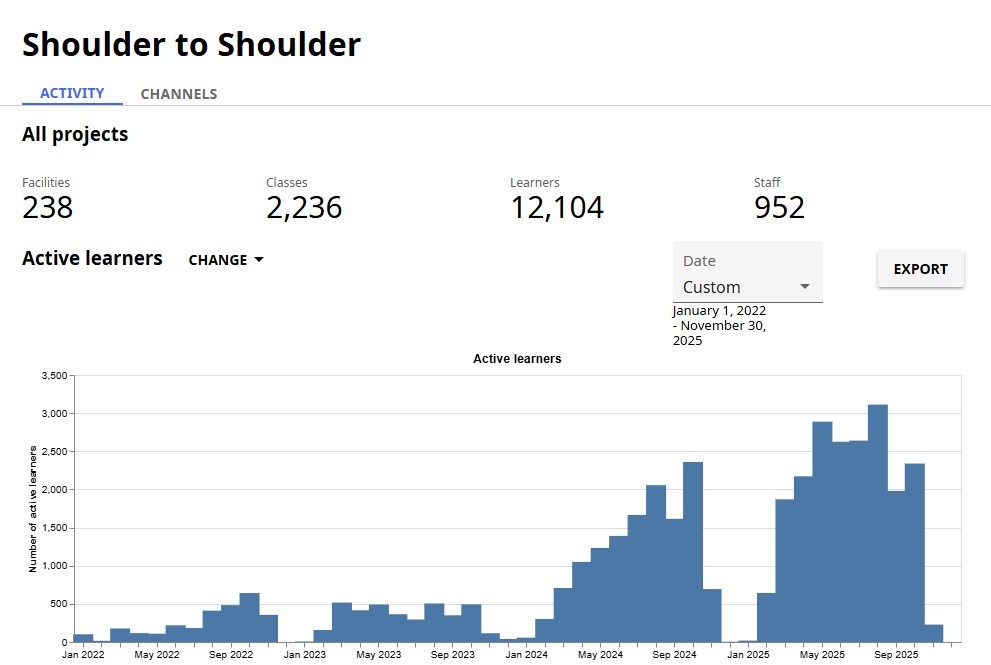
Transaction detail - Kolibri records every interaction for every device on an internal database. We have early access to the Kolibri Data Portal (KDP) which allows us to upload transaction records for all our devices to a central database from which we can produce reports and export data for impact analysis. The KDP chart below depicts active users since Jan 2022. (Note: schools were called off early in 2025 due to the election)
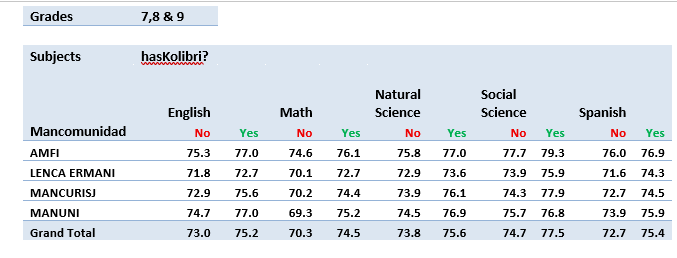
- Compare usage with grade averages- To measure impact, we correlate student Kolibri usage with the government grades and compare them to similar students who do not use Kolibri. The table below uses 429,977 grade records for 120,135 junior high individuals for 2023-2024 and shows the grades by subject summarized by four groups of municipalities called mancomunidads.
- Individual Achievement - In addition to the high-level averages, we can look at the distribution of the 120,125 individual student grades for each of the five core subjects with histogram and density charts overlayed by who use Kolibri vs those who do not.
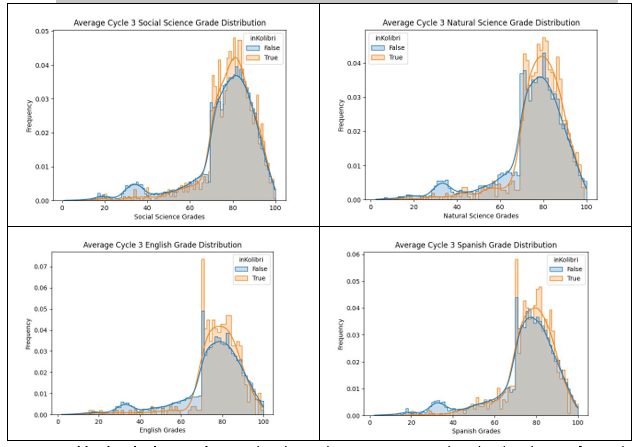
- Kolibri has higher grades - In the above charts, we can see that the distribution for each of the subjects (natural Science, Social Science, Spanish and English all show higher averages for Kolibri users versus non-Kolibri users. They also show something else that we want to look at closer for math, namely how Kolibri helps lower achieving students.
- Math shows the strongest Impact - This is evident in all the subjects as a bulge at the lower end of the grade distribution. For Math, we also did a “Box Chart” of the 12,250 math grades grouped by year and by whether they used Kolibri actively on tablets. The box chart displays the middle fifty percent in “the box” with the midline representing the median or middle of the set of Kolibri tablet using students and non-Kolibri students. The top quartile is above the box while the bottom quartile is below the box. Points outside of the guidelines or “whiskers” are called “outliers”. The Kolibri usage in 2024 was about five times that in 2023. So far, it looks like the 2025 usage sill be more than double that of 2024. In looking at the box charts, we can make two observations. First, the median Kolibri scores are higher for both 2023 and 2024. Second, in 2024, the gap in median score grew larger with the more intensive usage.
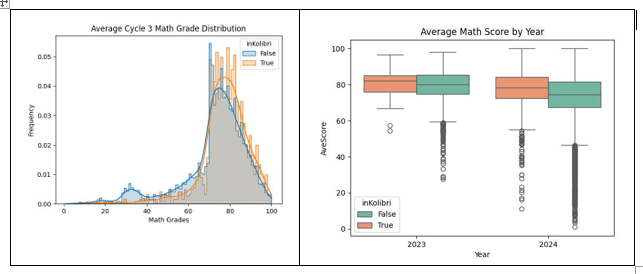
- Kolibri helps keep kids in school - The other significant observation is that the outliers below the distribution are significantly less in the Kolibri user data than in the general non-Kolibri students. We believe this is due to the ability for Kolibri users to review the material a second time AND to the superb quality of the math videos and interactive problem sets. Teaching math is hard and gets harder in higher grades, especially for teachers who are not strong in math. We believe the low outliers are precisely the students who are becoming hopelessly lost, most likely to become frustrated, and drop out of school.
- Retention - The most significant source of students dropping out of school is after the sixth grade or early in junior high as shown in the histogram below.
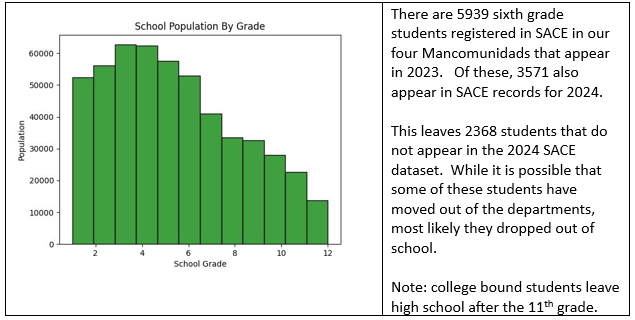
We have preliminary data that shows Kolibri schools retain a higher percentage of students than non-Kolibri schools, but this needs additional data from 2025 to confirm.
Supporting the Operation
Our strategy is to embed Kolibri into the local and regional municipal and educational organizations and make digital education technology and resources part of their jobs.
- Sustainability – Before getting equipment, each school plus the local parent group signs an agreement stating that they will utilize it for educational purposes and that they will replace equipment that becomes unusable or goes missing.
- Support Structure - Similarly, each mayor signs an agreement to provide IT support to the schools in their municipality. They also provide a large screen TV for each Kolibri server and router we provide. This year local mayors pledged about 100 TVs.
- Training Teachers - We develop teacher training material and deploy it to the mayor-provided IT resources. They visit schools and perform remedial training as needed and retrain new transfers that back fill for teachers transferring out of Kolibri schools.
- Teachers College Adoption – We introduced Kolibri into the regional teacher college last year. See https://hondurasrobot.org/revolutionizing-education-in-honduras/. Many of his faculty are using Kolibri along with new TVs in each of his classrooms to incorporate it into their college instruction. Also, four cohorts of 25 interns did their practicum in Kolibri schools. The College Director believes this is went well and wants to continue this program next year. The Director is sharing his results with the other six teacher colleges in Honduras.
Pillar Three 2025 Progress – Improve and enculturating Literacy:
- Reading Comprehension - Most Frontera Honduran homes do not contain books, so children learn to read in school and have little opportunity or incentive to read outside of class. Overall, reading comprehension is low which plays out in increasingly difficulty in mastering lessons in the higher grades. We added a CommonLit channel into Kolibri.
- Community Engagement - Our largest effort to improve literacy generally is to expand a community owned Reading Contest that was initially piloted in or bilingual school. This year we reached over 30,000 children in 2433 schools with 500 participating teachers. See 📚 Intibucá Reads, Dreams, and Grows: Progress of the 2025 Reading Program – -CREE-, Unlocking Minds, Building Futures: How Reading is Shaping Tomorrow’s Leaders in Intibucá – -CREE- and Igniting Minds – Reading Program 2024 – -CREE-.
- Digital Libraries – Our implementation of Kolibri features over 1000 digital books. We have deployed Kolibri servers in mayor offices and the Education department office lobby. Visitors can download a digital book onto their phone and take it with them for reading on the bus or at home.
Pillar Four Progress – Hands-on Job-Related Skills:
- Lego Robotics – We’ve deployed 8 EV3 educational robotics kits and trained teacher coaches to implement enrichment programs in 6 schools. We provide prizes for a mayor group run competitions. See Lego Regional Competition 2024 “Connecting the World” – -CREE- and Lego Regional Competition 2024 “Connecting the World” -Part 2 – -CREE-
- Vex Robotics - We also support a competition for older kids using VEX V5 equipment. See A Game That Inspires Minds. – -CREE-
- 3D Printing – See Learning About an Entirely New World -3D printing – -CREE- and 3D printing program- Making Brilliant Minds Flourish – -CREE-
- Photo Printer – We’ve recently added an Epson P-800 high quality photo printer to the STEM Center to compliment the full frame Nikon digital camera.
- Tools - The STEM center also provides basic machine tools for fabricating robotic parts.
Pillar Five Progress - Increase Access to higher Education:
Since its founding, Shoulder to Shoulder has encouraged education. Initially this was principally through scholarships which have served over 2,000 students since 2010. This year, there are 125 students in five high schools plus four in college. As noted above, Shoulder to Shoulder donors continue to support student attendance in the bilingual school regardless of means. We also deploy tablets to support dropout reentry back into school, see Opportunities + perseverance = Success! – -CREE-
To our valued community of donors, we want to express our deepest gratitude for your continued support. Please have the confidence that by investing in these children, you are truly making a lifelong difference!